Unlike Clint Eastwood’s classical western based on fiction, this post is about facts. Realities I personally witnessed on my 7-week visit to Malawi. I had a great time for most of my holiday and met some inspiring and helpful friends of old and new. Particularly in the southern regions where travelers aren’t as common, people are exceptionally forthcoming and humble. I was accepted and respected for who I am without expectations. The landscape, of what is left, is extraordinary from a photographer’s point of view. I have had some unforgettable wildlife experiences and off-road adventures, but…
I can’t turn a blind eye to the problems the country is facing. It’s the snowball effect that already turned into an avalanche. And that’s the Ugly Truth.
Malawi is one of the poorest countries in the world. Malawi is one of the densest populated countries in Africa. There are soooo many babies, kids, and teenagers here in Malawi, it isn’t funny anymore. All desperately asking for money or to buy food. The word ‘please’ doesn’t seem to exist in the Chichewa language, which is unusual, as ‘Zikomo’ means ‘thank you’. As soon as I am stationary, a group of people comes along, trying to sell or having business with me. Kids follow me on my walks through town. ‘Mzungu, give me money. Give me food!’ it demands. It gets a bit much.
Most kids know that knowledge is a powerful tool. Most kids want to go to school. Most kids can’t afford to go to school. The knowledge from school education is the first step out of poverty. School fees are unaffordable for the majority of Malawians. I had many requests to sponsor school kids, who are eager to return to school for the next term. I couldn’t help them all, as much as I would have liked to. The government could. The Ministry of Education could make it easier to educate the next generation. Even only on the fact to use condoms. But they are expensive and unavailable too. Having children is expensive in any country.
I find that Malawi is the most expensive country in Africa I have visited so far. These prices are based on everyday groceries and expenses. Fuel and diesel cost way more than in Europe. I paid for diesel 2800 Malawian Kwacha per liter, 2.60 $ Australian. These prices doubled on the black market as by the time of my departure, fuel shortages created chaos by parked cars near filling stations.
Corruption is also part of government officials, as much as politicians try to deny that. The majority of police I came across were friendly and helpful. But it’s only the few that spoil the party. Money talks.
I got stopped and pulled over by traffic police in Malawi’s southern district of Nacholo and ordered to pay 100 $ US. My Temporary Import Permit (TIP) only stated, that I could drive between Blantyre and Lilongwe, instead of saying, that I could drive anywhere in Malawi. The original fine was to be 1000 $US, but this law is only for heavy-duty trucks, not for small vehicles like Zimba. I disputed and argued for hours with the police, only to reduce the fine to 200000 Kwacha, a little more than 100 Dollars US.
I told my friend Chikonde in Lilongwe about this incident which left her embarrassed. She told the story to her aunt, who is involved with the government. She asked me to write an incident report and send it to her.

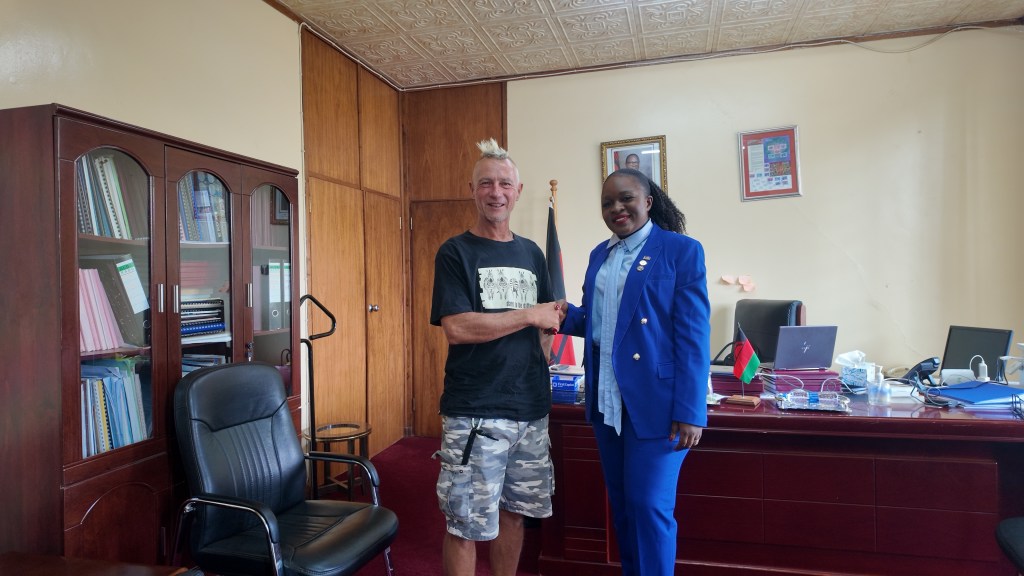
The following day, Chico and I drove to the government office of tourism. We met the Lady Minister of Tourism, who deeply apologized for this particular incident. She couldn’t tell if I get my money back.
The environmental disaster I witnessed on my travels is on an enormous scale. It was heartbreaking, passing empty fields with only tree stumps lining a majority of roads. Native trees are cut down to make charcoal for some income. The rest is used to build houses or fences. Others are cut down because the trees are in the way.
The natural waterways are filled with detergents, powders, soaps and you name whatever else is used. Add a mountain of rubbish as a topping, just for good measure. The few fish that wouldn’t survive had already been fished out. You can see plastic bottles and other rubbish anywhere you go, lots and lots of it. Burning plastic creates toxic gases in the atmosphere.
How is Mother Nature going to cope with that?
Imagine the devastation in a year’s time. In five years. Ten years?
It doesn’t take a scientific project to predict an ecological disaster.
 Travels with Ben